

Previous Art Projects Displays
Asad Azi
New Works
2025
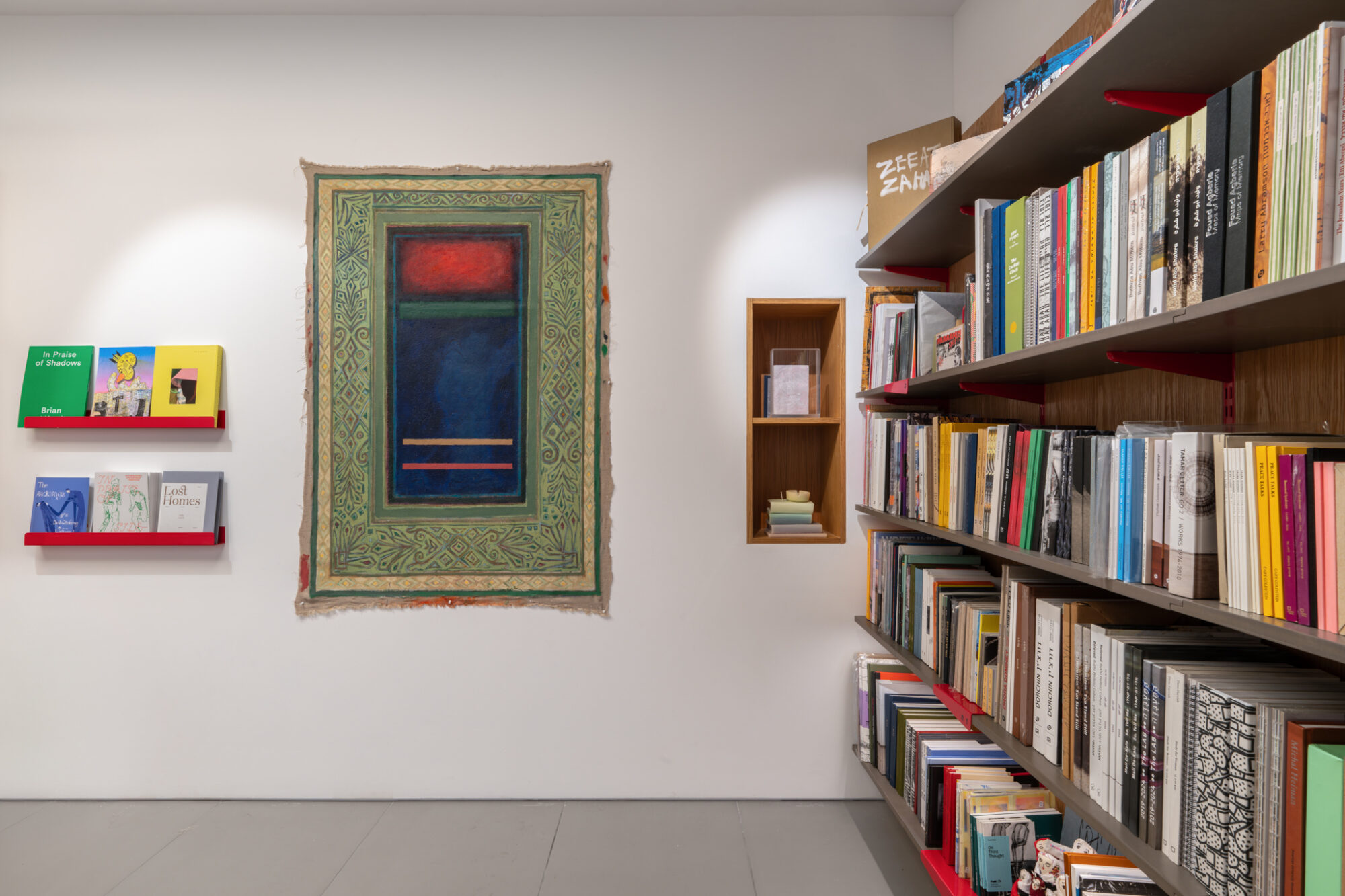
At the Magasin III Jaffa Bookstore, two new works by artist Asad Azi are on view: Red on Blue (2025) and Unstable Ground (2025), from his ongoing Carpets series – a project he has been developing for many years. In these works, Azi weaves together popular carpet traditions with a visual language inspired by modern art – a homage to artists such as Mark Rothko and Lucio Fontana. The carpet serves as a space of identity, memory, and visual poetry – a meeting point of matter, color, and spirit. Speaking about his work, Azi notes:
[1]“I am a painter who prays through his painting… I draw on certain qualities of the carpet – primarily its composition, which divides the surface into a frame and a central field. Unlike the traditional carpet, I reconstruct the frame and fill it with different content. In fact, I create a secular icon.”
- From an interview with Assad Azi by Haim Maor.
The interview was conducted in collaboration with Sarit Shapira and published in Studio magazine, issue no. 11, May 1990, pp. 18–23.
___________
Asad Azi
Born in Shefa-‘Amr in 1955, lives and works in Jaffa. He holds a BFA from the University of Haifa and an MA in Art History from Tel Aviv University. Until his retirement, Azi taught at the University of Haifa and at the Art Institute of Beit Berl College.
Azi’s work is influenced by questions of personal, human, and political identity, stemming from his reflections on his own position as an individual living between worlds. His art engages with the tension between Arabness and Israeliness, and expresses the cultural, ethical, and stylistic contrasts between East and West.
He has exhibited in numerous solo and group exhibitions, including at the Tel Aviv Museum of Art, the Israel Museum in Jerusalem, the Haifa Museum of Art, and the Herzliya Museum of Contemporary Art. Azi is the recipient of the Ministry of Culture’s Art Encouragement Award, the “Yad Leyaad” Award from the President of Israel, the Rotary Prize, and a Lifetime Achievement Award from the Ministry of Culture.
Photos: Daniel Hanoch
Previous Vitrine Displays
Jan Tichy
Marginal Notes on Israel
2023
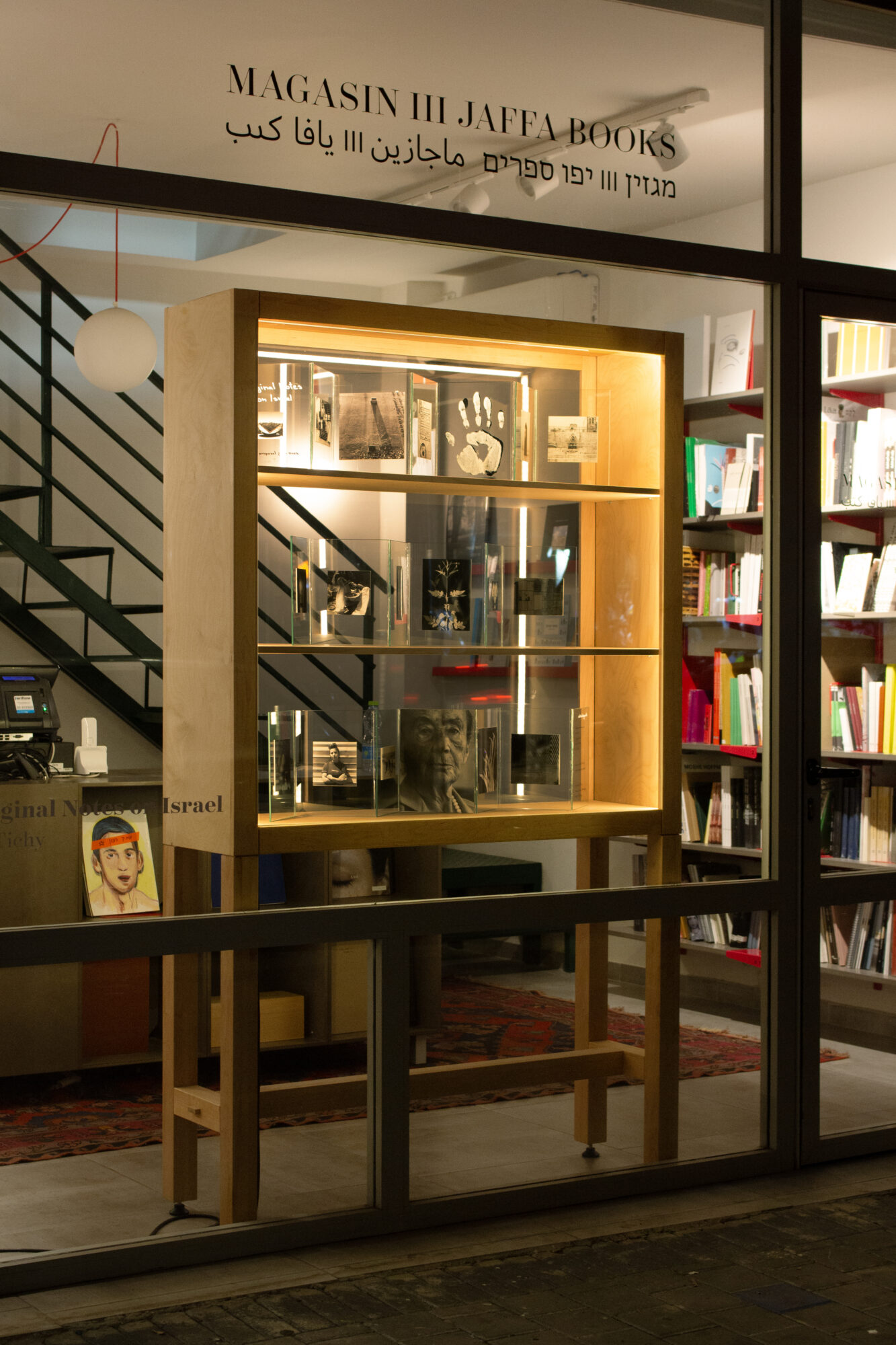
Since 2007, Jan Tichy, an artist and an Associate Professor at the School of the Art Institute of Chicago, has been researching the work and life of Lucia Moholy (1894–1989), a Jewish photographer born in Prague. Tichy, also born in Prague, conducts a dialogue with Moholy’s legacy, striving to shed light on the gaps in her personal and professional history. For the past six years, he has been working as a co-curator, designer, and participating artist, together with co-curators Meghan Forbes and Jordan Troeller, on a comprehensive exhibition centered on Moholy’s life and work, which will be presented in 2024 at the Kunsthalle Praha in the city where they were both born and raised.
Between 1923 and 1928, after marrying László Moholy-Nagy, an artist and one of the Bauhaus masters, Moholy was part of the team that founded the School. Among other things, she documented the architecture, products, and people of the school in Weimar and subsequently in Dessau. In 1933, following the Nazi rise to power in Germany, just a few years after the couple returned to Berlin and separated, Moholy was forced to leave Germany in a hurry, leaving behind all her possessions, including the glass negatives of the aforesaid photographs. During World War II, all traces of the glass negatives were lost. Moholy later discovered that they had been used without giving her credit for her work, and that over the years they had been attributed to someone she trusted, Walter Gropius, the first director of the Bauhaus School. While researching the history of art and photography, photographing, editing, and documenting, and becoming an expert in microfilm documentation, Moholy continued to struggle for years to get the recognition she deserved and reobtain the negatives. Of the 570 negatives she left in Berlin, all documented in a card index she took with her, Moholy managed to locate and regain possession of only 240. As part of his research, in recent years Tichy managed to locate 20 more of these negatives in Moholy-Nagy’s estate.
Standard chronology has it that Moholy visited Israel in 1956, and two of her photographs, kept in the Bauhaus Archive in Berlin, whose prints are included in the work Marginal Notes on Israel, are associated with that visit. A closer look at Moholy’s passport, however, tells a different story. The passport photographs, which are also presented by Tichy as part of the same work, indicate two important facts: Moholy’s visit to the region in 1956 took place in the eastern part of Jerusalem, which in those years was part of Jordan, so that those two photographs, considered the two last photographs she ever took, were actually taken in Jordan, and not in Israel; in 1966 Moholy visited Israel for a month, a visit that was never mentioned, neither by her nor in any previous research done on her.
Based on his deep familiarity with Moholy’s work, Tichy surmises that she intended to use the photographs she took in 1956 for a book proposal, as she did on other occasions with photographs she took around the world. Tichy, who came to Israel from Czechoslovakia in 1995 and has been working in Chicago since 2007, took advantage of a short visit to Israel and used gaps in Moholy’s story to create his own proposal for an artist’s book, addressing his own affinities with the place through the perspectives used by Moholy when she photographed Israel 67 years ago, and the themes she addresses—photography, documentation, writing, female portraits, and architecture. Tichy’s artist’s book consists of 20 glass plates, as the number of Moholy’s glass negatives that Tichy managed to locate. The panels are identical in size (18×24 cm) to the glass plates used by Moholy. Tichy uses glass as a surface on which he presents, among other things, photographs taken by Moholy and by himself, a portrait of Moholy by photographer Giorgio Hoch, a documentation of her passport, photograms, and filmstock. Moreover, the title of the artist’s book, Marginal Notes on Israel, is also a tribute to Moholy, who in 1972 published a book entitled Moholy-Nagy: Marginal Notes, Documentary Absurdities, which exposed misconceptions regarding Moholy-Nagy’s work.
The book Ascendants: Bauhaus Handprints Collected by László Moholy-Nagy, closely related to the issues that preoccupy Tichy in his work on Moholy, is also available at the bookshop of Magasin III Jaffa. The book was co-edited by Tichy and scholar Dr. Robin Schuldenfrei and published at IIT (Chicago Institute of Design) Press.
Photos: Dafna Amira
Michael Liani
N/A
2023
Negative injekt, 111 X 108 cm
14.3.2023 – 14.7.2023
In his new work for Magasin III Jaffa Books Vitrine, N/A, Michael Liani exhibits a photo displaying four objects. Two hands and two prayer chains. At the end of each prayer chain hangs a logo, one that can be recognized even before the figure itself is absorbed. Nike/Adidas. Using only these four elements Liani exposes us to a collection of possibilities through which one can examine the world around us. Black/White, East/West, Holy/Secular, Art/Consumerism. Using humor to gently push us out of our comfort zone, Liani propels us to carefully review how deeply we consider our daily choices.

Dana Yoeli
Through a Glass Darkly
27.10.2022 – 3.2.2023
Although a quick glance at Dana Yoeli’s work, Through a Glass Darkly, is enough to realize that it is an imaginary theatrical scene, perhaps a scale model or a trick of another kind that combines these two, the eye still wanders, seeking for a structure, looking to establish a certain logic. The gaze scans the objects in a desperate attempt to connect shreds of ruins from the Parthenon, resting upon Doric and Corinthian order columns, backgrounded by a brutalist concrete wall in a modern architectural style. The horror emerges when among to the ruins, the viewer discovers several life-sized fingers as well as a classical sculpture of a nose, next to a miniature replica of the Elgin horse, that same horse that is named not after its creator but rather after Lord Elgin, who tore it from its origin in the Parthenon, and led it into the collection of the British Museum.
Into a 130 square cm space, with a title made of three-words, Yoeli manages to engage in a array of cultural references dated in different periods and disciplines, from theater and cinema through visual arts and architecture, and at the same time pull those out of the context in which we are used to seeing them. When Bergman’s film shares a stage with the ruins of Greek temples and a finger pointing at the horrific damages of colonialism, Yoeli forces us to confront questions regarding the identity of the forces that control the narratives told through these cultural assets. Yoeli signs the work with the words “to err is human”, and what could have been a consolation can also be read as an accusation.

Roni Packer
Zero Separation
7.7.2022 – 23.9.2022
Roni Packer’s studio practice revolves around color and paint, and the wish to bring forward the abundance of these two on a flat surface. In Zero Separation, Packer’s installation for Magasin III Jaffa bookstore’s vitrine, she takes a step back from her color practice to reclaim the surface underneath the paint. Instead of a brush, she worked on the raw canvas with an iron, highlighting the off-white cloth, creating a double-sided canvas piece. Packer never used red in her work, but in this mini installation she is asking to proclaim Polly Apfelbaum’s red*. She does that with one thin line at the edge of the raw canvas, a red seam which she uses to set a boundary. However, it wasn’t enough. Packer missed the paint. And so, at the foot of the canvas piece, she places a skin of paint, a surface without a surface. The perpendicular canvas and the horizontal skin of paint are two individual pieces, yet a complete separation is not an option. On top of the red paint skin Packer sets a sculpture of a circle figure.
“And, just as the outside of a Cube is a Square, so the outside of a Sphere presents the appearance of a Circle.” (Flatland, Edwin A. Abbott, p 65).
*Apfelbaum’s exhibition Red Desert, Red Mountain, Red Sea is currently exhibited at Magasin III Jaffa, across the street from the bookstore’s vitrine.

Sivan Lavie
My lucky heart
21.4.2022 – 11.6.2022
Sivan Lavie wonders how she can expand a field for the audience, to gift them with an experience of space and breathing. Color and circles are part of her answer. Beat and rhythm of brightly colored dots floating in white emptiness create movement for the audience she imagines, like musical notes, and reflect joy, allowing an inner dance. Thus she creates another world, a parallel universe, more colorful and flowing than the one we already know.

Ra’anan Harlap
Ba’asa
Used construction wood, 2021.
20.1.2022 – 11.4.2022
Ra’anan Harlap hangs a wooden soccer ball in the air. It cannot be played with, and it is suspended in a location where a ball could not remain. It is all the impossible possibilities; all the lost hopes. Haralp names the work Ba’asa, after the big pond that used to accumulate in past winters at the Bloomfield Stadium area, and caused the cancellation of the soccer games, to the chagrin of the players and fans. Today, the work is exhibited at 17 Olei Zion Street, on the soccer fans’ way to the renovated Bloomfield Stadium. Rain will no longer cancel the game but hopes still hang in the air.
The possibility of representing three-dimensional bodies in two dimensions has intrigued Harlap for many years. In previous works he presented aligned pits[1] and flat tables[2], created illusions using the perception of space. But this time he is doing the opposite: he is rebuilding the geometric body of soccer ball from the two-dimensional remains of building boards, his favorite material. 20 hexagons and 12 pentagons are used to revive the ball, which manages to fuse the flat wooden shapes into a lasting wonder and an inexhaustible object of passion.
[1] Pit, 2011
[2] Table, 2013
