

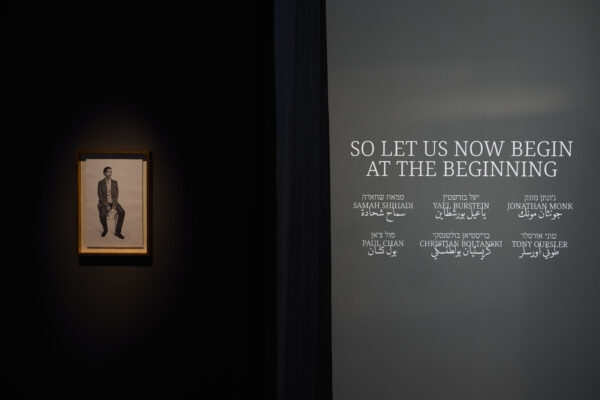
SO LET US NOW BEGIN AT THE BEGINNING
Note from Sandra Weil, Magasin III Director
As we open So Let Us Now Begin at the Beginning at Magasin III Jaffa, I am filled with a profound sense of gratitude. I have had the privilege of growing up alongside Magasin III since its founding in Stockholm in 1987 by David Neuman and my father, Robert Weil. Last year, I took on the leadership of Magasin III, and I cannot imagine a more meaningful way to begin this new chapter than through this exhibition.
Bringing together works from a collection that has shaped me throughout my life feels both deeply personal and inspiring.The artists featured in this exhibition offer a glimpse into the many artists who, over the decades, were invited to experiment and push boundaries at Magasin III, and whose work has profoundly shaped my understanding of art.
Today, I am honored to bring together four groundbreaking artists—born in Paris, Leicester, Hong Kong, and New York—whose work first inspired me in Stockholm, alongside two remarkable artists born in Jaffa and Sha’ab. This exhibition is, for me, a testament to my deep belief in art’s power to connect, to transform, and to unite us in extraordinary ways. It also represents another building block in the bridge that the Robert Weil Family Foundation—Magasin III’s sole supporter—has been constructing for more than a decade toward a stronger democracy and a more sustainable, equal, and just society.
To curate this exhibition with Karmit Galili who has tirelessly steered the ship as the director of Magasin III Jaffa since its opening in 2018 is an honor.
Thankful to the rest of the team here Amit, Anna and Sandy and to the Stockholm team as well Thomas, Erik, David and Nina, none of this would have been possible if it was not for the team work that is behind it all.
Sandra Weil
The group exhibition So Let Us Now Begin at the Beginning brings together works by four internationally renowned artists from the Magasin III Collection with works by two local artists. Christian Boltanski, Paul Chan, Jonathan Monk, and Tony Oursler each have a longstanding and close relationship with Magasin III Museum for Contemporary Art and have previously been presented at its exhibition space in Stockholm, in group and solo shows. Meanwhile, the exhibition marks the first presentation of works by artists Yael Burstein and Samah Shihadi at Magasin III Jaffa.
Turning to the collection, at a time of isolation, both cultural and physical, when the movement of artworks, artists, and institutions across Israeli borders has become increasingly fragile, is not merely a practical gesture, but also an opportunity to reconsider these works through the circumstances and contexts of the present moment. The works, previously exhibited in Stockholm, acquire a different resonance in Jaffa – one shaped by time, the local context, and a new audience encountering them here for the first time.
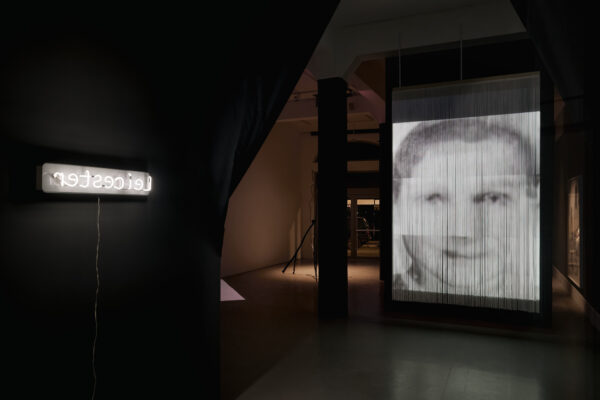
Taking its title from Jonathan Monk’s work, the exhibition revolves around the desire to begin again – a longing that, in recent years in Israel, has taken on an especially urgent and painful tone: the hypothetical possibility of returning to the moment when things might still have taken another shape. Monk’s neon work (2006) presents the artist’s birthplace, Leicester, written backwards and upside down. Both playful and disorienting, the work proposes a kind of mechanical reversal — a gesture that carries the self-aware simplicity of an almost childlike fantasy: to rewind history itself. Yet it also points to the impossibility of truly returning to the way things were before.
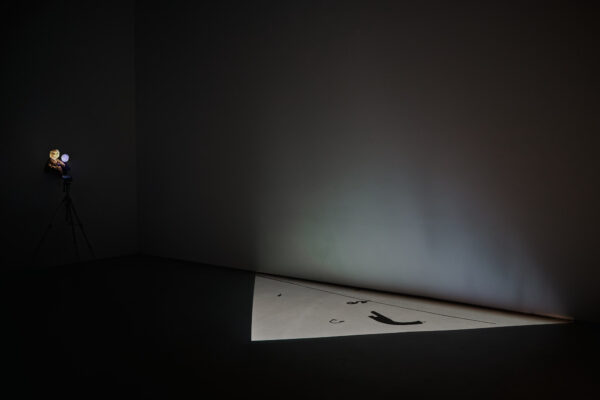
Across the exhibition, bodies, faces, shadows, and identities repeatedly appear as if suspended between disappearance and reconstruction. In Christian Boltanski’s Être à nouveau (Being Anew) (2005), anonymous obituary black and white portraits are endlessly recombined into unstable composite faces, as though memory itself is attempting to resist finality of loss. Paul Chan’s 5th Light (2007) transforms the visual language of the September 11 catastrophe into a haunting meditation on creation and destruction. Falling bodies and drifting objects, including weapons shattering into fragments—evoke both biblical imagery and collective trauma. As the colors of light gradually shift from morning to evening, the work unfolds as a reflection on catastrophe and the human search for hope. Tony Oursler’s work Get It Right )1995) projects human facial expressions onto motionless dolls, blurring the line between the tangible and the imagined. Their shifting faces and voices feel at once strange and intimately familiar and fix onto the figures expressions and emotions that would normally vanish in the blink of an eye.
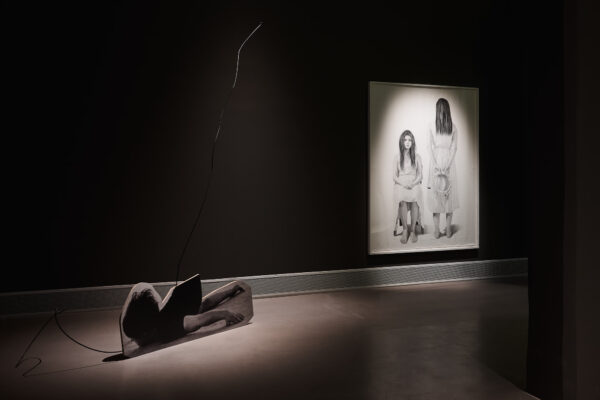
Alongside these works, Yael Burstein’s and Samah Shihadi’s works approach the body as a vulnerable site shaped by rupture, memory, and transformation. In Burstein’s sculpture Gravity and Grace (2026), a figure close to the ground resists fixed meaning, suspended between collapse and renewed ascent. Confronting the fragility of the human body, Burstein also presentsScribble (2020), a wild yet stable primordial form that even the light cast upon it cannot fully recover. Shihadi’s powerful and realist self-portraits, Two Women in One (2017) and Facing(2016), negotiate the tension between representation and a reality that resists it, while at the same time preserving the lives they depict and bearing witness to their fragility.
Throughout the exhibition, video works projected onto unexpected objects, sculptures and drawings, discuss the possibility – as well as the impossibility – of beginning again repeatedly emerges. This renewed beginning is not necessarily synonymous with moving forward; rather, it is first and foremost a reflection on the human desire to erase what has happened and to imagine another future out of the ruins of the present. It is closer to an attempt to trace the dimensions of shared catastrophe, loss, and mourning, while acknowledging that even what cannot be repaired continues to demand form and meaning.
Curators: Sandra Weil and Karmit Galili
Artist Biographies
Christian Boltanski
born in 1944 in Paris (France), was a French artist who lived and worked in Paris until his death in 2021. One of the most important conceptual and installation artists of his generation, Boltanski worked across sculpture, photography, painting, film, installation, and theater. His work explored themes of memory, absence, mortality, and collective history, often using everyday materials such as photographs, clothing, lights, and sound as traces of human presence.
Boltanski’s permanent works and long-term projects are located around the world, focusing on memory, loss, and the fragile traces of individual lives. Among them is Les Archives du Cœur on Teshima Island, Japan, a growing archive of recorded heartbeats collected from people around the world. Related recording stations have been presented in different locations, including Jupiter Artland near Edinburgh, Scotland, allowing visitors to contribute their own heartbeat to the archive. In Paris, several of Boltanski’s works are permanently installed at the Musée d’Art Moderne de Paris.
Selected solo exhibitions include Centre Georges Pompidou, Paris; Museum of Contemporary Art, Chicago and Los Angeles; Whitechapel Art Gallery, London; Grand Palais, Paris; Park Avenue Armory, New York; The Israel Museum, Jerusalem; Power Station of Art, Shanghai; and Centre Pompidou, Paris. His work has also been presented in major international exhibitions including documenta, Kassel (1972, 1977), and several editions of the Venice Biennale, including the French Pavilion in 2011. Boltanski’s works are included in permanent collections at leading institutions worldwide, including The Museum of Modern Art, New York; Tate, London; and Centre Georges Pompidou, Paris.Boltanski had a longstanding and significant relationship with Magasin III Museum for Contemporary Art. His works are included in the collection and have been presented in several exhibitions over the years, including Les archives, I’m Still Here, and In the Eye of the Beholder. In this context, the 2008 solo exhibition Les archives, curated by Tessa Praun, marked an important moment in the development of Les Archives du Cœur. Presented as a new work created with the participation of visitors, the project invited audiences in Stockholm to donate recordings of their heartbeats. From this starting point, Boltanski began to build the archive that would later become permanently housed on Teshima Island, Japan.
Yael Burstein
born in Israel in 1974, is an artist who lives and works in Jaffa. Working across collage, drawing, sculpture, and installation, Burstein’s practice is based on the collection and transformation of images from various sources. Through processes of cutting, enlarging, and transferring images into space, she creates works that move between two-dimensional composition and sculptural installation, often functioning as a form of drawing in space.
Her work explores the relationship between mental and physical spaces, drawing on imagery of empty domestic interiors, natural landscapes, and ethnic and tribal masks. These elements are reconfigured into photographic collages, two-dimensional sculptural works, and wallpaper installations that merge with the walls of the exhibition space.
Selected solo exhibitions include Herzliya Museum of Contemporary Art and Tel Aviv Museum of Art, as well as galleries in Israel and France. Group exhibitions include the Kupferman Collection, Kibbutz Lohamei Haghetaot; The Israel Museum, Jerusalem; Inga Gallery, Tel Aviv; and Tel Aviv Museum of Art. Her works have also been presented at international fairs and festivals including Paris Photo, Les Rencontres d’Arles, and Untitled Miami, and are held in public and private collections in Israel and internationally.
Paul Chan
born in 1973 in Hong Kong, is an artist who lives and works in New York. From the outset of his career, Chan has worked simultaneously as a political activist and an artist. His varied practice ranges from animated video projections and charcoal drawings to public performances, experimental publishing, and pneumatic sculptures. His political engagement has also taken the form of activist projects and public interventions, from anti-war work around Iraq to Waiting for Godot in New Orleans (2007), a community-based project developed with artists, activists, and residents in the aftermath of Hurricane Katrina. Drawing on artistic, philosophical, literary, and political references, his work often explores the relationship between image, language, time, and power. In 2010, he founded the experimental publishing house Badlands Unlimited.
Selected solo exhibitions include Serpentine Gallery, London; New Museum, New York; The Renaissance Society at the University of Chicago; Schaulager, Basel; Deste Foundation Project Space, Hydra; Solomon R. Guggenheim Museum, New York; Pennsylvania Academy of Fine Arts, Philadelphia; Remai Modern, Saskatoon; and Museum of Cycladic Art, Athens. His work is included in major public collections, including The Museum of Modern Art, New York; Solomon R. Guggenheim Museum, New York; Whitney Museum of American Art, New York; Walker Art Center, Minneapolis; Stedelijk Museum, Amsterdam; Art Institute of Chicago; Hammer Museum, Los Angeles; and Museum of Contemporary Art, Los Angeles.
Chan’s work is included in the collection of Magasin III Museum for Contemporary Art. His work has been presented at Magasin III in the solo exhibition Paul Chan and in the group exhibition BETWIXT.
Jonathan Monk
born in 1969 in Leicester, UK, is a British artist who lives and works in Berlin and Rome. His work revisits and reinterprets key moments in Conceptual and Minimal art through a practice marked by wit, appropriation, and repetition. Working across photography, sculpture, wall painting, installation, and text, Monk often draws on the legacy of artists such as Sol LeWitt, Ed Ruscha, Bruce Nauman, and Lawrence Weiner, while questioning ideas of originality, authorship, and artistic value.
Selected solo exhibitions include Centro de Arte Contemporáneo de Málaga, Spain; Irish Museum of Modern Art, Dublin; CAN Centre d’art Neuchâtel, Switzerland; Kunsthaus Baselland, Muttenz/Basel, Switzerland; VOX, Montréal; CCA Tel Aviv-Yafo; and KINDL Centre for Contemporary Art, Berlin. Group exhibitions include Kunsthalle Wien, Austria; EMMA, Espoo; Kunsthalle Krems, Austria; Schirn Kunsthalle Frankfurt; and Centre Pompidou, Paris. His work has also been presented in major international exhibitions including the Berlin Biennale (2001), the 50th and 53rd Venice Biennales (2003, 2009), and the Whitney Biennial (2006).
Monk’s works are included in the collection of Magasin III Museum for Contemporary Art. His work was presented at Magasin III in the group exhibition BETWIXT.
Tony Oursler
born in 1957 in New York, USA, is an American artist who lives and works in New York. His work explores the evolving relationship between image, identity, and belief systems, drawing on subjects such as telecommunications, conspiracy theories, social media, facial recognition, mysticism, and environmental concerns. Combining projected faces, fragmented narratives, and sculptural forms, Oursler blurs the boundaries between the virtual and the physical, while positioning the viewer as an active participant.
Selected solo exhibitions include Kunstverein Hannover, Germany; Whitney Museum of American Art, New York; Kunsthaus Bregenz, Austria; Helsinki City Art Museum, Finland; Metropolitan Museum of Art, New York; ARoS Aarhus Kunstmuseum, Denmark; Pinchuk Art Centre, Kyiv; Stedelijk Museum, Amsterdam; Hessel Museum of Art, Bard College, Annandale-on-Hudson; Museum of Modern Art, New York; Guild Hall, East Hampton, New York; Musée d’arts de Nantes, France; and Kaohsiung Museum of Fine Arts, Taiwan. His work has also been presented in major international exhibitions including documenta VIII and IX, Kassel.
Oursler has a longstanding and significant relationship with Magasin III Museum for Contemporary Art. His work was presented in two major solo exhibitions at Magasin III: Tony Oursler – Station in 2002, and Tony Oursler – Mr>0r*. In addition, his works have been included in several group exhibitions and special projects at Magasin III over the years.
Samah Shihadi
born in 1987 in Sha’ab village, is a Palestinian artist who lives and works in Haifa. Working primarily in hyperrealist drawing, Shihadi belongs to a younger generation of Palestinian women artists and is one of the distinctive voices in the local art scene. Her work examines questions of identity, gender, family structures, and the traditional society to which she belongs, while also addressing the political reality in which she lives.
Through precise and highly detailed drawing, Shihadi explores the tension between the personal and the social, the inner self and external expectations. Her works often focus on the position of women within family and society, offering a feminist perspective that gives form to lived experience, social pressure, and the power relations embedded in patriarchal structures.
Selected solo exhibitions include Umm El-Fahem Art Gallery; Tabari Artspace, Dubai; Tel Aviv Museum of Art; and Cromwell Place, London. Group exhibitions include Haifa City Museum; Mémoire de l’Avenir, Paris; Kunstmuseum Bochum, Germany; Jordan National Gallery of Fine Arts, Amman; and The Israel Museum, Jerusalem. Her works are included in private and public collections, including the Tel Aviv Museum of Art, LACMA, and the Fenix Museum.